Sooner or later, every operator of a sewage treatment plant, process water basin or storage tank faces the same question: how do we check what is going on inside, and fix it, without causing more trouble than the problem itself? Emptying a large tank takes planning, produces water that may need special disposal, and can disturb the rest of the process. It is no surprise that many people search for a sewer tank service before they have decided how the work should be done.
This guide explains the options in plain terms. You will see what a sewer tank service typically covers, how to weigh draining against working in a filled tank, what happens during an underwater inspection, and what information makes the planning easier. At the end, you should be able to judge which route suits your tank, and what to ask before you commission anything.
What Is a Sewer Tank Service and What Problems Does It Solve?
A sewer tank service is any planned work to inspect, clean or repair the tanks and basins in a wastewater system. Typical jobs include checking the condition of settling tanks, clarifiers and aeration basins, clearing sediment and deposits, servicing valves, and repairing equipment such as aerators. The common thread is that you want to know the condition of an asset you cannot see from the surface, and fix problems before they become failures.
The tasks listed on TRITON’s sewage treatment plant and tank diving page give a good picture of the range: visual inspection with video documentation, underwater inspection and repair of gate and butterfly valves, replacing or repairing membrane and tube aerators, sediment removal and high-pressure cleaning, and sealing cracks, joints and penetrations. If you are not sure which of these applies to you, a documented inspection is usually the first step, because it tells you what, if anything, needs to be done next.
Should You Drain the Tank or Keep It in Service?
Draining is the traditional route, and for some jobs it remains the right one. When you compare the two routes, three practical factors usually decide: how long the tank can be out of operation, what happens to the water you remove, and how long it takes to refill and restart. Work in a filled tank is attractive when downtime is costly or when contaminated water would be expensive to dispose of. TRITON describes exactly these points as the benefits of its underwater approach, and it says the total cost can be lower than a conventional overhaul, which is worth testing against a quotation for your own tank.
Safety belongs in the same comparison. The German accident-insurance rule DGUV Regel 113-004 on work in containers, silos and confined spaces states that you should first check whether the work can be avoided, for example by cleaning from outside or by camera inspection. If people must enter, it calls for a risk assessment, a permit to work, a supervisor and at least one safety attendant. Diving work follows its own rules, which we explain in our article on DGUV Regulation 40, so the useful question is not which route is easier, but which one gives you the safer, better-documented result for this particular tank.
What Happens During an Underwater Tank Inspection or Cleaning?
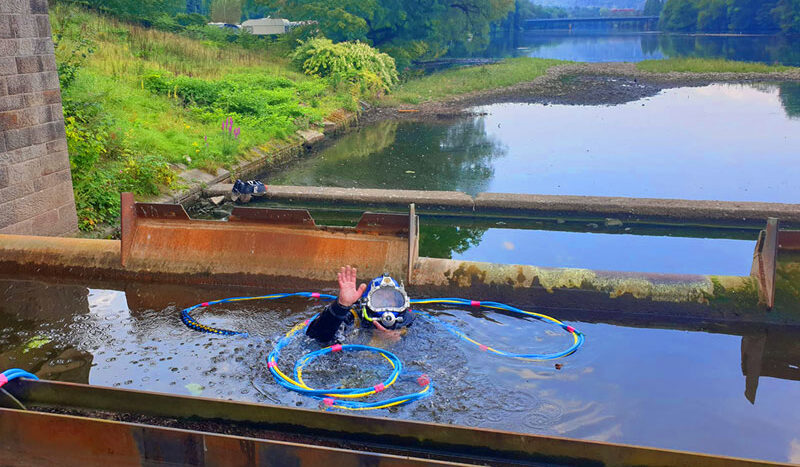
Knowing the sequence makes it easier to prepare. In our introduction to commercial diving we describe four stages. First, a site survey looks at access, tank type and conditions. Second, the quotation and planning stage produces a dive plan and a safety concept. Third, the work is carried out with a diving supervisor, a standby diver and a tender/signalman on site. Fourth, the findings are documented with photos, video and reports.
For a tank, the documentation is often the most valuable part. Video and photos of the walls, floor, valves and aerators give you a record you can compare with later inspections, share with colleagues or use for maintenance planning. If a repair is carried out, such as sealing a crack or a joint, the record shows what was done and where, which helps if the question comes up again years later.
Which Tanks and Basins Benefit from Regular Checks?
Wastewater tanks are the obvious case, but they are not the only one. Underwater tank services are described for municipal sewage treatment plants, industrial process water basins and cooling water systems, firefighting water reservoirs and sprinkler tanks, drinking water reservoirs and elevated storage tanks, and large aquariums. What these have in common is that they are expensive or inconvenient to take out of service, and that a hidden fault can have large consequences.
If your concern is a pipe or culvert rather than a tank, the approach is similar but the tools differ. Underwater visual surveys, CCTV inspection and leak detection are described on the page for culvert inspection and pipe water testing. A short description of your asset is usually enough for a diving contractor to tell you which approach fits.
What Should You Prepare Before Asking for a Sewer Tank Service?
A little preparation saves a lot of back-and-forth. Note the type and dimensions of the tank, what it contains and how long it has been in service, how it can be accessed, and what drawings or earlier inspection reports exist. Then decide what you want to get out of the work: a general condition check, a documented record, the removal of deposits, or the repair of a known fault.
Also think about timing. Which parts of the plant depend on this tank, and when would a work window disturb you least? If you are unsure about any of this, you do not have to solve it alone. The TRITON team in Bochum is happy to talk it through by phone on +49 170 773 5760, by email at mail@taucherteam-triton.de, through the quote request form or on the contact page. Our services overview shows the other underwater tasks we handle, in case your project involves more than one.