If you manage a bridge, a port, a lock or an industrial plant, there will come a day when something under the waterline needs attention and you have no direct way to see it. That is usually the moment when commercial diving enters the picture, and it is often a moment when people have more questions than answers: what exactly will happen, what will it involve on our side, and how do we know it will be done safely?
This guide walks through those questions in the order they tend to come up. It explains what commercial diving is, how to describe your problem clearly, which type of work fits which structure, what safety checks you can expect, and what a project looks like from start to finish. The aim is that you understand the process before you ask anyone for a quotation.
What Is Commercial Diving and When Do You Need It?
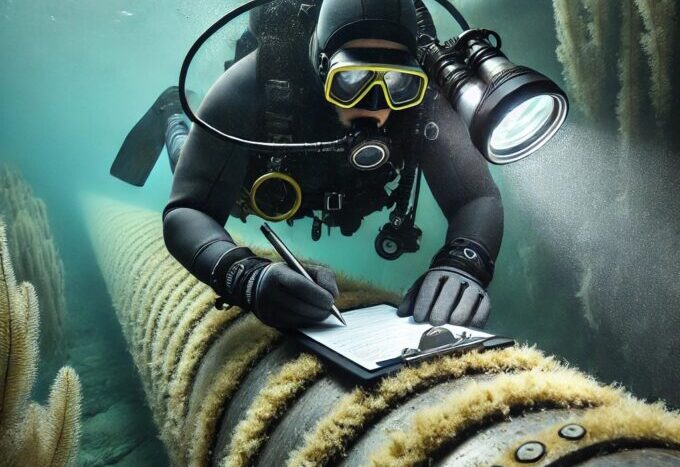
Commercial diving means industrial underwater work: inspecting, maintaining, repairing or building structures below the waterline. Typical examples are inspecting bridge piers and quay walls, cleaning or repairing tanks and weirs, laying scour protection and clearing obstacles. In Germany, this work falls under DGUV Regulation 40, which sets the rules for training, equipment, working methods and rescue arrangements.
You usually need it when a structure cannot be checked or worked on from above, or when taking the asset out of service would be more disruptive than working underwater. Our article Commercial Diving: Definition, Applications and Certified Process gives the full overview if you want the background, and the construction diving service page shows how new construction, demolition, inspection and rehabilitation are covered.
How Do You Describe Your Underwater Problem Clearly?
Start with what you want to achieve. A condition check for a regular structural inspection, a repair, a new installation and the removal of an obstacle are very different jobs, and each needs its own equipment and its own report. Then describe the structure and its surroundings: the type and size, the water depth if you know it, the current, the visibility and how people and equipment can reach the site.
Add whatever paperwork you have, such as drawings, earlier inspection reports and photos, and say what you need to receive at the end, for example a report for a statutory inspection. You do not need to have all the answers. An honest description of what you know and what you do not is the best starting point, because the site survey is there to fill the gaps.
Which Type of Commercial Diving Work Matches Your Structure?
Different structures call for different services. For bridges, underwater bridge pier inspection follows DIN 1076 and RI-EBW-PRÜF and includes crack and scour measurement and video documentation. For ports, quay wall renovation covers inspections, obstacle removal and maintenance, and port and waterway engineering addresses underwater work and the upkeep of structures on and in the water.
Further tasks have their own pages. Geotextile laying and scour protection deals with shores and beds, sheet pile inspection covers sheet piling, and ordnance under the water covers survey, clearance and recovery in coordination with the authorities. If your structure is not on the list, that is fine: describe it, and the right approach can usually be worked out together.
What Safety and Qualification Checks Should You Expect?
You are entitled to ask who will do the work and how safety is managed. TRITON states that all operations are carried out according to DGUV regulation 40 and that its professional divers are DGUV-certified, and that each operation includes a qualified diving supervisor, a standby diver and a tender/signalman. The article on DGUV Regulation 40 and certified diver work explains what the regulation covers, from qualifications and equipment to emergency plans.
Supporting systems matter too. The DGUV Information 201-025 on the diver’s service logbook states that divers must complete an occupational health screening before they start diving work, again after 12 months and then regularly, at the latest after three years, and that each dive is entered in the logbook on the same day. You can ask any contractor how it handles medical checks, equipment inspection and dive records, and how this feeds into the documentation you will receive.
What Does a Commercial Diving Project Look Like from Start to Finish?
Most projects follow four stages. A site survey looks at access, conditions and risks. The quotation and planning stage produces a dive plan and a safety concept. The work itself is carried out a diving supervisor, a standby diver and a tender/signalman on site. Finally, the results are documented with photos, video, inspection reports and measurement protocols. Knowing this lets you plan your own part: site access, permits, and who will receive and use the report.
A real example helps. TRITON’s reference project, Emmelsum Port: quay inspection and wall thickness measurement in North Rhine-Westphalia, shows the kind of quay work this process leads to. If you need something similar, a reference like this is a useful way to explain to a contractor what kind of result you expect.
What Are the Next Steps If You Are Ready to Ask?
Once you have a short description of the structure, the objective and the timing, you are ready to start a conversation. You can send it through the quote request form or the contact page. For construction diving, the service page states “Free quote within 24 hours”.
If you prefer to talk first, call TRITON in Bochum on +49 170 773 5760 or write to mail@taucherteam-triton.de. Tell them what you know and what you are unsure about, and they will help you work out which service fits and what to prepare. You can also look through the full list of services beforehand.